




Forklift Pencil Beam Warning Light: The Smart Way to Improve Warehouse Safety
In modern industrial and logistics environments, safety and visibility are top priorities. Forklifts operate constantly in warehouses, factories, and distribution centers, often in tight spaces with limited lighting. Accidents caused by blind spots, pedestrian movement, and low visibility can result in serious injuries or costly property damage. To reduce these risks, forklift pencil beam warning lights have become an essential safety feature in many facilities.
This article explores how these lights work, their technical specifications, and how they enhance safety in demanding work conditions.
1. What Is a Forklift Pencil Beam Warning Light?
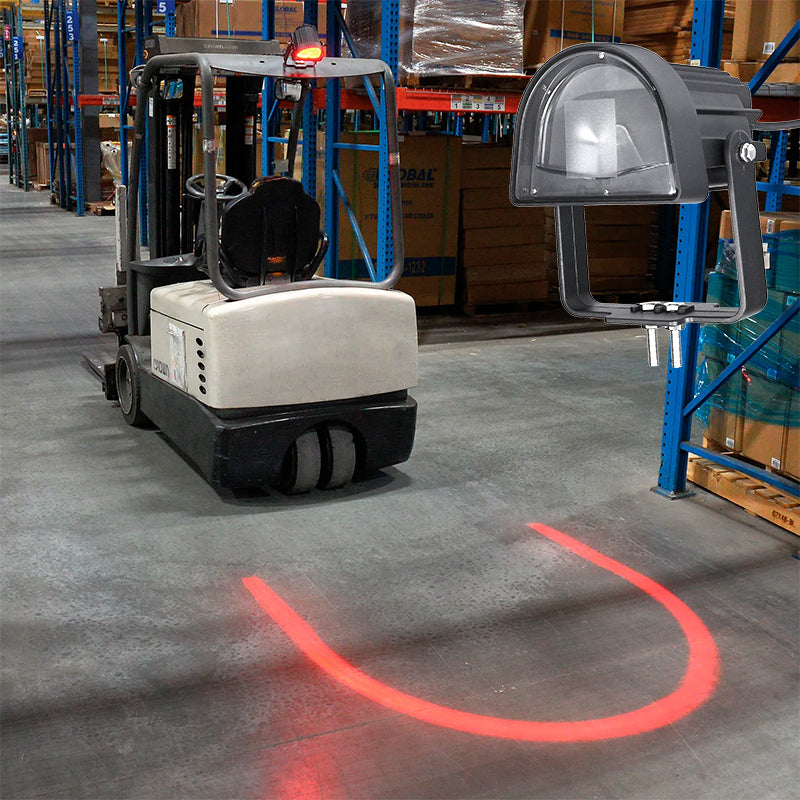
A forklift pencil beam warning light is a compact, high-intensity LED light that projects a narrow, focused beam—usually in blue or red—onto the ground in front of or behind the forklift. This bright line acts as a visual warning signal, alerting nearby pedestrians and other operators of the forklift’s presence and movement direction.
Unlike flood or spot beams, the pencil beam creates a precise, concentrated line instead of a wide spread of light. This focused design ensures the warning is clearly visible without causing glare or distractions in the workplace.
2. Key Features and Technical Specifications
The forklift pencil beam warning light is engineered for durability and long-term performance, even in harsh industrial environments. Based on the product specifications:
-
Light Source: High-power CREE LED, 2pcs × 3W
-
LED Power: 6W total
-
Operating Voltage: 10–80V DC (or 10–110V customizable)
-
Working Temperature: -40°C to 80°C
-
Lifespan: Over 50,000 hours
-
Beam Type: Pencil beam (narrow, long-range projection)
-
Color Options: Blue or red
-
Material: Aluminum die-cast housing, stainless steel bracket, PC cover
-
Protection Rating: IP68 / CE / ROHS
-
Additional Features: Reverse polarity protection, double insulated silicon rubberized wire, EMC optional
This combination of features ensures that the light performs reliably under extreme temperatures, dust, humidity, and vibration, which are common conditions in warehouses and construction sites.
3. Why Choose a Pencil Beam Instead of a Flood Beam?
Many forklifts use flood beams for general illumination. However, a pencil beam light is specifically designed for safety signaling rather than lighting up an area. Here’s how it differs:
| Feature | Pencil Beam | Flood Beam |
|---|---|---|
| Light Pattern | Narrow, focused line | Wide area illumination |
| Purpose | Safety warning signal | Work area visibility |
| Visibility | Highly visible from a distance | Less distinct |
| Best Use Case | Pedestrian and forklift collision prevention | General work lighting |
In essence, the pencil beam serves as a predictive visual alert—workers can see where the forklift is heading before it reaches them, allowing more time to react.
4. Safety Benefits in the Workplace
Installing forklift pencil beam lights brings measurable safety improvements:
a. Preventing Pedestrian Accidents
Pedestrians walking near forklift paths often rely only on sound to detect nearby vehicles. In noisy warehouses, this can be ineffective. The bright blue or red light projected on the floor provides a clear visual indicator of an approaching forklift, reducing the chance of collisions.
b. Improving Operator Awareness
The light not only protects pedestrians but also helps forklift drivers maintain awareness of their vehicle’s movement direction, especially in tight corners or crowded aisles.
c. Suitable for Indoor and Outdoor Use
With a wide working voltage range (DC10–80V) and robust weatherproof construction (IP68 rating), these lights can be installed on forklifts, reach trucks, pallet stackers, and other industrial vehicles operating both indoors and outdoors.
d. Cost-Effective Safety Upgrade
Compared to complex sensor systems or AI-based safety equipment, pencil beam lights are affordable, easy to install, and require no software maintenance, yet they deliver immediate safety benefits.
5. How to Install a Forklift Pencil Beam Light
Installation is simple and can be done by maintenance staff with basic tools:
-
Choose the Mounting Position:
Typically, the light is installed on the top front or rear of the forklift mast, depending on where the warning projection is needed. -
Adjust the Beam Angle:
Aim the beam so that the projected line appears a few meters ahead of the forklift. This ensures pedestrians see the warning before the vehicle arrives. -
Connect the Power:
Use the forklift’s DC power supply (10–80V). The light includes reverse polarity protection, preventing accidental wiring errors. -
Test the Projection:
Ensure the light projects clearly on the warehouse floor under normal lighting conditions.
6. Durability and Performance in Harsh Environments
Forklifts often operate in environments exposed to dust, vibration, moisture, and extreme temperatures. The pencil beam warning light is designed to withstand all these challenges:
-
Aluminum Die-Cast Housing: Offers superior heat dissipation and corrosion resistance.
-
PC Lens Cover: Protects LEDs from impact and chemical exposure.
-
Double Insulated Silicon Wire: Maintains flexibility and insulation in very high or low temperatures.
-
IP68 Waterproof Rating: Ensures protection against water ingress, making it ideal for cold storage, food processing plants, and outdoor yards.
The long lifespan of over 50,000 hours means minimal maintenance and reduced downtime.
7. Application Scenarios
Forklift pencil beam lights can be installed on various industrial vehicles:
-
Forklifts – for front or rear pedestrian warning.
-
Reach trucks – for signaling when extending or retracting forks.
-
Pallet movers and stackers – to indicate direction of movement.
-
Warehouse loaders and AGVs (Automated Guided Vehicles) – for collision prevention in automated zones.
Their compact size and universal voltage make them suitable for new installations or retrofitting existing fleets.
8. Compliance and Certification
The light meets CE, ROHS, and IP68 standards, ensuring compliance with international safety and environmental regulations. Optional EMC certification guarantees that the light does not interfere with other electronic systems in the facility.